





Seawater Pump Supplier Singapore – Singapore’s No 1 Best Pump service & supplier
The Ultimate Engineering Guide to Seawater Pumping Systems in Industrial, Marine, and Desalination Applications
Fluid dynamics in industrial and maritime settings demand specialized machinery capable of enduring extreme mechanical, chemical, and electrochemical conditions Seawater Pump Supplier Singapore . When handling raw seawater, the engineering complexity increases exponentially compared to fresh water applications. Selecting the right Seawater Pump Supplier Singapore is a multi-million-dollar decision for procurement managers, vessel owners, and infrastructure planners.
Singapore serves as a global maritime hub and an industrialized island nation reliant on reverse osmosis desalination, marine infrastructure, and ship repair. The regional ecosystem requires highly durable, anti-corrosive, and hydrodynamically efficient fluid systems.
This comprehensive guide breaks down the core fluid dynamics, metallurgy, hydraulic designs, system integrations, and procurement strategies necessary to successfully deploy industrial-scale seawater pumping systems.
1. The Physics and Chemistry of Seawater Fluid Dynamics Seawater Pump Supplier Singapore
Seawater is not just salt water; it is a highly volatile, chemically active electrolyte containing dissolved gasses, living microorganisms, suspended solids, and a complex matrix of chloride ions. To design a pumping system that lasts for decades rather than months, a certified Seawater Pump Supplier Singapore must analyze the operational parameters of the specific fluid.
Chemical Composition and Electrochemical Conductivity
Open-ocean seawater typically has a salinity of approximately 35 grams per liter, corresponding to a total dissolved solids (TDS) concentration of about 35,000 parts per million (ppm). The primary culprits behind structural failures in pumping systems are chloride ions ($\text{Cl}^{-}$).
Chloride ions disrupt the passive oxide film that naturally forms on standard steels, initiating localized corrosion cells. Additionally, the high concentration of dissolved salts increases the electrical conductivity of the fluid, turning the entire pump casing and impeller assembly into a massive galvanic battery if mismatched metals are placed in close proximity.
Fluid Density, Viscosity, and Vapor Pressure Seawater Pump Supplier Singapore
Seawater is denser and more viscous than pure water. At $20^\circ\text{C}$, the density of standard seawater ($\rho$) is approximately $1025 \text{ kg/m}^3$ compared to $1000 \text{ kg/m}^3$ for fresh water.
$$\rho_{\text{seawater}} \approx 1025 \text{ kg/m}^3$$
This increase in density directly alters the pump’s brake horsepower (BHP) calculations:
$$\text{BHP} = \frac{Q \times H \times SG}{367 \times \eta}$$
Where:
- $Q$ = Flow rate ($\text{m}^3/\text{h}$)
- $H$ = Total dynamic head (m)
- $SG$ = Specific Gravity (1.025 for seawater)
- $\eta$ = Hydraulic efficiency
A pump configured for Seawater Pump Supplier Singapore fresh water will overload its electric motor if forced to pump seawater without adjusting the motor power or trimming the impeller diameter. Furthermore, variations in sea temperature alter the vapor pressure of the liquid, which significantly impacts the Net Positive Suction Head Available ($\text{NPSH}_A$).
An experienced Seawater Pump Supplier Singapore recalculates these dynamic variables to ensure the motor has an adequate safety margin and the system avoids destructive cavitation.
Biofouling and Microorganism Settlement
Singapore’s tropical waters remain consistently warm throughout the year, hovering between $27^\circ\text{C}$ and $30^\circ\text{C}$. This warmth accelerates the growth of marine organisms such as barnacles, mussels, tube worms, and macroalgae Seawater Pump Supplier Singapore
When raw seawater enters a pump intake, these organisms adhere to the low-velocity zones inside the suction bell, impeller shrouds, and diffuser vanes. As biofouling accumulates, it restricts the cross-sectional area of the fluid pathways, increasing friction losses, altering the hydraulic balance, and causing severe localized crevice corrosion beneath the biological mass.
2. Wear Mechanisms in Corrosive Environments Seawater Pump Supplier Singapore
A prominent Seawater Pump Supplier Singapore distinguishes itself through its ability to diagnose, predict, and mitigate structural wear before it leads to catastrophic system failure. The interaction of high-velocity fluid flow with a highly corrosive medium results in three primary wear mechanisms.
                  +-----------------------------------+
                  |      Seawater Degradation         |
                  +-----------------------------------+
                                    |
         +--------------------------+--------------------------+
         |                          |                          |
         v                          v                          v
+------------------+       +------------------+       +------------------+
| Chloride Pitting |       |    Cavitation    |       |   Galvanic and   |
|   and Crevice    |       |   and Erosion    |       |  Electrochemical |
|    Corrosion     |       |    Corrosion     |       |    Corrosion     |
+------------------+       +------------------+       +------------------+
         |                          |                          |
         v                          v                          v
Destruction of outer       Implosion of vapor         Dissimilar metals
protective oxide film      bubbles gouging metal      forming a galvanic
in low-flow crevices.      under high velocity.       corrosion cell.
Chloride-Induced Pitting and Crevice Corrosion Seawater Pump Supplier Singapore
Standard austenitic stainless steels, such as Grade 304 or Grade 316, rely on a microscopic layer of chromium oxide ($\text{Cr}_2\text{O}_3$) to resist corrosion. In stagnant or low-velocity zones—such as under gaskets, within mechanical seal chambers, or beneath biofouling layers—the oxygen required to maintain this passive film is depleted.
Chloride ions then penetrate the weakened film, creating micro-anodes. The surrounding passive metal acts as a massive cathode, driving a highly accelerated localized dissolution of the metal. This leads to deep pits and hidden structural cracks that can cause sudden structural failures while the exterior of the pump appears perfectly intact.
Cavitation and Erosion-Corrosion Seawater Pump Supplier Singapore
Cavitation occurs when the local static pressure within the pump falls below the vapor pressure of the seawater, causing vapor bubbles to form. As these bubbles travel into regions of higher pressure within the impeller, they violently implode. The micro-jets generated by these implosions produce localized pressures reaching several gigapascals, physically tearing metal fragments from the impeller surfaces.
When combined with the abrasive action of suspended sand particles commonly found in Singapore’s coastal waters, this mechanical damage continuously strips away any protective passive oxide layers. The raw, exposed metal undergoes immediate chemical oxidation, a combined mechanical-chemical destruction loop known as erosion-corrosion.
Galvanic and Electrochemical Corrosion Seawater Pump Supplier Singapore
A pump assembly contains multiple interconnected parts: the casing, impeller, shaft, wear rings, and fasteners. If these components are fabricated from different metals with distinct electrochemical potentials, a galvanic cell forms across the conductive seawater.
The less noble metal (the anode) corrodes rapidly, while the more noble metal (the cathode) remains protected. For example, pairing a standard cast iron casing with a stainless steel impeller will cause the casing to degrade rapidly. A qualified Seawater Pump Supplier Singapore ensures all internal components are metallurgically compatible or isolates them using specialized coatings and sacrificial anodes.
3. Metallurgical Excellence: Material Selection Criteria Seawater Pump Supplier Singapore
The selection of metallurgy determines both the upfront capital cost and the long-term operational lifespan of a seawater pump. A knowledgeable Seawater Pump Supplier Singapore matches the material selection to the specific fluid velocities and operating pressures of the application.
| Material Class | Grade / Composition | Corrosion Resistance | Max Fluid Velocity | Common Applications |
| Austenitic Stainless Steel | Grade 316L (Low Carbon) | Moderate; prone to pitting in stagnant seawater. | $\approx 2.5 \text{ m/s}$ | Intermittent use, short-run shipboard systems. |
| Duplex Stainless Steel | Grade 2205 (Ferritic-Austenitic) | High resistance to pitting and stress corrosion cracking. | $\approx 4.0 \text{ m/s}$ | Ballast water transfer, desalination pre-treatment. |
| Super Duplex Stainless Steel | Grade 2507 / Zeron 100 | Exceptional; resistant to high-chloride environments. | $> 6.0 \text{ m/s}$ | SWRO high-pressure feed pumps, offshore platforms. |
| Nickel-Aluminum Bronze | NAB (CuAl10Fe5Ni5) | Good overall resistance; forms a protective copper oxide layer. | $\approx 3.0 \text{ m/s}$ | Marine cooling loops, firewater pumps, shipboard bilge. |
| Titanium | Grade 2 / Grade 5 | Immune to seawater corrosion across all temperatures. | $> 10.0 \text{ m/s}$ | Highly critical naval applications, specialized chemical processing. |
Austenitic Stainless Steel (316L)
While cost-effective and easy to machine, 316L stainless steel has limitations in raw seawater applications. Its Pitting Resistance Equivalent Number ($\text{PRE}_N$) sits around 23 to 25.
$$\text{PRE}_N = \%\text{Cr} + 3.3(\%\text{Mo} + 0.5\%\text{W}) + 16(\%\text{N})$$
For reliable performance in raw seawater, a $\text{PRE}_N$ greater than 40 is preferred. If 316L is used, the system must remain continuously active to prevent stagnant water from initializing crevice corrosion. Partnering with a reliable Seawater Pump Supplier Singapore helps clarify when 316L is acceptable and when a system requires an upgrade to more robust materials.
Duplex (2205) and Super Duplex (2507) Stainless Steel
Featuring a balanced 50/50 microscopic structure of austenite and ferrite phases, duplex stainless steels provide double the mechanical yield strength of standard austenitic steels along with superior corrosion resistance. Super Duplex 2507, with a $\text{PRE}_N$ exceeding 42, contains high levels of chromium, molybdenum, and nitrogen.
This material provides excellent protection against pitting, crevice corrosion, and erosion-corrosion under the high-velocity, high-pressure conditions typical of Sea Water Reverse Osmosis (SWRO) desalination facilities.
Nickel-Aluminum Bronze (NAB) Seawater Pump Supplier Singapore
Nickel-Aluminum Bronze remains a preferred material for marine hull valves and shipboard seawater circulation pumps. When exposed to seawater, NAB forms a continuous, adherent surface film of copper oxide mixed with aluminum oxide.
This film provides reliable protection against erosion-corrosion and reduces biofouling, as the slow release of copper ions creates an environment hostile to marine organisms. However, NAB remains vulnerable to accelerated wear if exposed to high-velocity fluids containing abrasive sand particles.
Titanium Alloys
Titanium forms a highly stable, instantaneous passive oxide film when exposed to oxygen, providing excellent corrosion resistance in seawater across all practical velocity and temperature ranges.
Because it is immune to chloride attack, titanium is often utilized in critical naval vessels, subsea oil production equipment, and specialized industrial facilities. Consult with your chosen Seawater Pump Supplier Singapore to evaluate the structural advantages of titanium against its higher upfront capital cost.
4. Key Pump Configurations Deployed in Seawater Applications Seawater Pump Supplier Singapore
Different industrial processes require distinct hydraulic configurations. A full-service Seawater Pump Supplier Singapore offers an expansive fleet of pump designs tailored to specific spatial, pressure, and flow constraints.
Vertical Turbine Pumps (VTPs)
Vertical Turbine Pumps are the standard choice for coastal industrial water intakes, power plant cooling loops, and desalination lift stations. By submerging the impellers directly in the intake wet pit, VTPs eliminate the need for priming systems and minimize suction lift challenges.
               [ Motor / Thrust Bearing ]
                          ||
                          ||  <-- Line Shaft
       ===================||===================  [ Deck Level ]
                          ||
                          ||  <-- Column Pipe (Seawater Filled)
                          ||
                +---------||---------+
                |   [Bowl Assembly]  |
                |   [Stage 3 Impeller] |
                |   [Stage 2 Impeller] |
                |   [Stage 1 Impeller] |
                +---------||---------+
                          ||
                          \/  <-- Suction Bell / Strainer
- Flow Range: $100 \text{ to } 15,000 \text{ m}^3/\text{h}$
- Head Range: $10 \text{ to } 300 \text{ m}$
- Engineering Focus: Requires long line shafts supported by specialized rubber or ceramic cutless bearings lubricated directly by the pumped seawater. A certified Seawater Pump Supplier Singapore ensures precise vertical shaft alignment to prevent premature bearing wear caused by structural vibration.
End-Suction Centrifugal Pumps
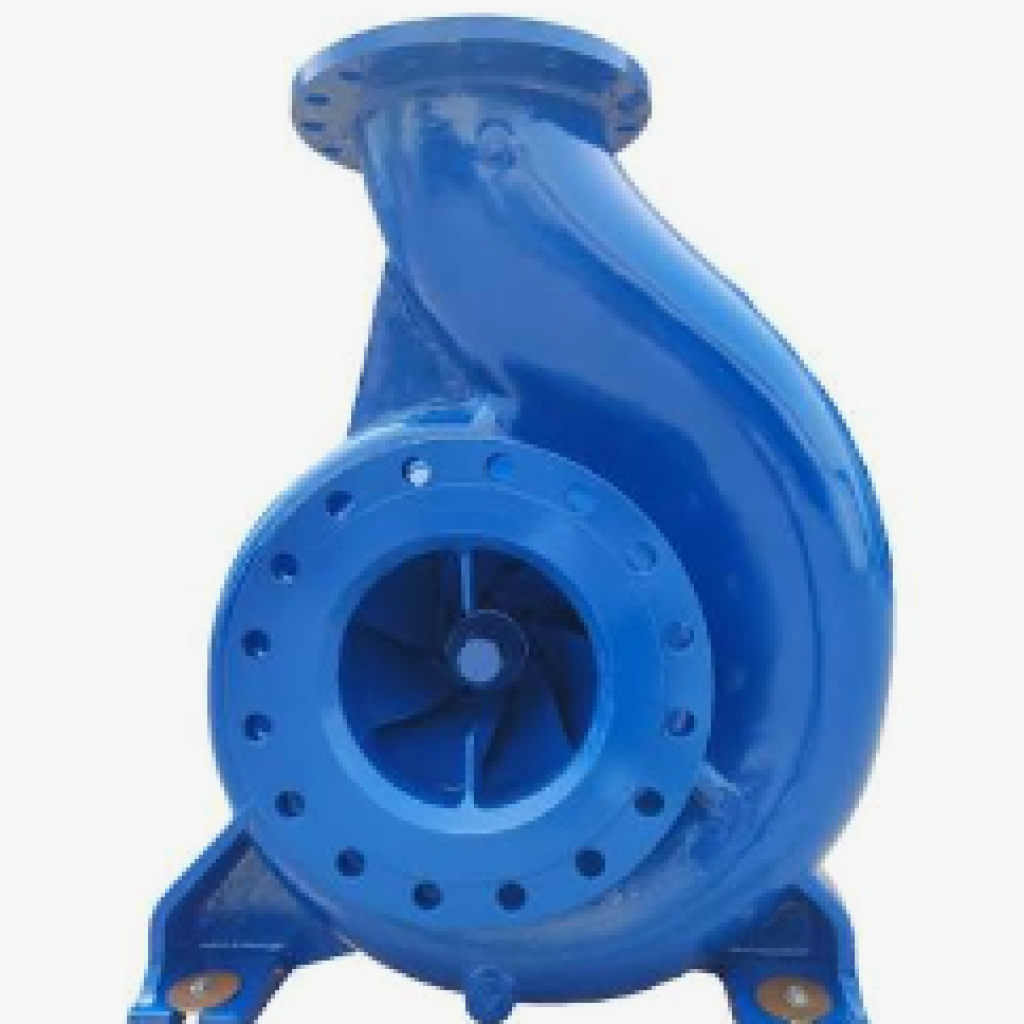
End-Suction Centrifugal Pumps are widely used for shipboard ballast transfer, bilge pumping, and localized industrial chemical processes. Their simple design features a horizontal suction inlet along the shaft axis and a top vertical discharge.
- Flow Range: $10 \text{ to } 800 \text{ m}^3/\text{h}$
- Head Range: $5 \text{ to } 100 \text{ m}$
- Engineering Focus: These pumps are typically designed with a back pull-out configuration, allowing maintenance teams to remove the impeller, shaft, and mechanical seals for servicing without disconnecting the main suction and discharge piping work.
Horizontal Split-Case Pumps
For high-capacity municipal water distribution and main condenser cooling loops, horizontal split-case pumps provide excellent reliability and ease of maintenance. The pump casing is split along a horizontal plane, allowing operators to inspect the internal double-suction impeller and bearings by removing the top casing cover without disturbing the motor alignment.
- Flow Range: $500 \text{ to } 25,000 \text{ m}^3/\text{h}$
- Head Range: $15 \text{ to } 150 \text{ m}$
- Engineering Focus: The double-suction impeller design balances the axial hydraulic forces acting on the shaft, reducing load wear on the thrust bearings and extending the overall operational life of the pump components.
Submersible Marine and Drainage Pumps
Designed for temporary or permanent submersion, these compact units are utilized for emergency shipboard dewatering, offshore caisson drainage, dock construction, and ballast tank stripping.
- Flow Range: $5 \text{ to } 500 \text{ m}^3/\text{h}$
- Head Range: $10 \text{ to } 800 \text{ m}$
- Engineering Focus: These systems require double mechanical seals operating in an isolated oil chamber, coupled with moisture sensors that alert operators to any water ingress before it reaches the electrical motor windings. Work closely with an experienced Seawater Pump Supplier Singapore to ensure the submersible cables and sealing compounds match the operational depths of your project.
5. Mechanical Seals and Bearing Architecture
The structural integrity of a seawater pump depends heavily on the performance of its mechanical seals and bearings. If these sub-components fail, seawater can quickly penetrate the bearing housings, resulting in shaft seizure or catastrophic failure of the drive motor.
Mechanical Seal Faces and Elastomers
Traditional gland packing is rarely sufficient for modern, high-pressure seawater installations due to continuous leakage and subsequent crystal accumulation on the shaft. Instead, industrial systems utilize balanced mechanical seals.
- Seal Face Materials: Silicon Carbide (SiC) paired against Silicon Carbide or Tungsten Carbide (WC) provides the hardness required to resist abrasion from sand and salt crystals.
- Springs and Metallurgy: All metallic seal components—such as the springs, drive pins, and retainer rings—must be fabricated from highly stable alloys like Alloy C-276 or Titanium to prevent localized stress corrosion cracking.
- Elastomers: O-rings must be constructed from highly resilient Fluorocarbon (FKM) or Ethylene Propylene Diene Monomer (EPDM) compounds rated for continuous exposure to warm marine environments.
Seal Flush Plans (API Plans) Seawater Pump Supplier Singapore
To maintain clean, stable conditions inside the seal chamber, a professional Seawater Pump Supplier Singapore integrates standard API seal flush plans into the system design:
- API Plan 11: Delivers a recirculation flush from the pump discharge port through an orifice straight to the seal faces, providing cooling and preventing localized fluid stagnation.
- API Plan 32: Injects a clean, external fresh water flush into the seal chamber. This creates a positive pressure barrier that pushes seawater away from the seal faces, protecting them from abrasives and salt crystallization during standby periods.
- API Plan 53A/B: Utilizes a pressurized barrier fluid reservoir to isolate volatile or high-pressure fluids, ensuring zero seawater leakage across the primary seal faces.
Bearing Sealing and Lubrication Seawater Pump Supplier Singapore
Bearings must be isolated from the surrounding marine environment using non-contacting labyrinth seals or magnetic bearing isolators. For vertical pumps submerged in raw seawater, line shaft bearings are typically constructed from water-lubricated synthetic elastomers or technical ceramics, allowing the pumped fluid itself to lubricate the bearing surfaces without risk of oil contamination.
6. Hydraulic Performance Optimization and System Integration
A highly efficient seawater pump can still underperform if it is poorly integrated into the overall fluid piping system. Achieving optimal lifecycle efficiency requires careful analysis of the entire hydraulic network.
+------------------------------------------------------------------------+
|                     SYSTEM EFFICIENCY OPTIMIZATION                     |
+------------------------------------------------------------------------+
                                    |
      +-----------------------------+-----------------------------+
      |                                                           |
      v                                                           v
+---------------------------------------+   +---------------------------------------+
|        Hydraulic Design               |   |          System Integration           |
+---------------------------------------+   +---------------------------------------+
| * Anti-cavitation profiling           |   | * Variable Frequency Drives (VFDs)    |
| * Semi-open impeller optimization     |   | * Smooth geometric intake piping      |
| * Minimized friction & losses         |   | * Targeted biocide dosing loops       |
+---------------------------------------+   +---------------------------------------+
Optimizing Net Positive Suction Head ($\text{NPSH}$)
To eliminate the risk of cavitation, the Net Positive Suction Head Available ($\text{NPSH}_A$) within the piping network must exceed the Net Positive Suction Head Required ($\text{NPSH}_R$) by the pump across its entire operating range, typically maintaining a minimum safety margin of 0.5 to 1.0 meter.
$$\text{NPSH}_A > \text{NPSH}_R + \text{Safety Margin}$$
Calculating $\text{NPSH}_A$ requires precise measurement of local atmospheric pressure, suction fluid elevation, friction losses within the intake piping, and the vapor pressure of the seawater at maximum operational temperature. A qualified Seawater Pump Supplier Singapore uses advanced software to verify these parameters, preventing cavitation issues prior to onsite installation.
Variable Frequency Drives (VFDs) and System Controls
Seawater demand in industrial applications—such as vessel cooling loops or desalination facilities—fluctuates based on seasonal environmental temperatures and varying production schedules.
Operating fixed-speed pumps against restrictive control valves wastes significant energy and accelerates mechanical wear. Integrating Variable Frequency Drives (VFDs) allows operators to automatically adjust pump rotational speed to match real-time system demand. This optimization lowers energy consumption, minimizes internal turbulence, and extends the operational lifespan of the entire system.
Intake Piping and Filtration Design Seawater Pump Supplier Singapore
The design of the intake system is critical for preventing debris ingress and maintaining uniform, non-turbulent fluid flow into the pump suction port. Suction piping should feature gradual geometric transitions and avoid sharp elbows to minimize localized pressure drops and uneven velocity profiles.
Integrating automatic self-cleaning strainers or multi-stage trash racks protects internal components from seaweed, marine life, and large debris, ensuring stable hydraulic conditions.
Integrating Anti-Fouling Systems Seawater Pump Supplier Singapore
To control biological growth within the pump casing and downstream piping, the pumping system should include targeted biocide dosing ports. Periodically injecting low concentrations of sodium hypochlorite ($\text{NaOCl}$) or utilizing copper-alloy internal components generates a protective localized environment that prevents marine larvae from settling on internal surfaces, maintaining optimal flow efficiency.
7. Operational Best Practices: Installation, Maintenance, and Control Seawater Pump Supplier Singapore
Long-term reliability relies on strict adherence to structured installation, operation, and maintenance protocols. Even the highest-grade super duplex pump can fail prematurely if subjected to improper alignment, continuous dry running, or poor maintenance practices.
Precision Foundation Alignment and Leveling Seawater Pump Supplier Singapore
During installation, the pump and motor assembly must be securely mounted on a rigid, vibration-dampening concrete or reinforced steel foundation base. Maintenance teams use laser alignment tools to verify co-axial alignment between the pump and motor shafts, keeping tolerances within fractions of a millimeter.
Proper alignment prevents uneven loads on the Seawater Pump Supplier Singapore bearings, minimizes mechanical seal deflection, and reduces overall structural vibration during high-speed operation.
Comprehensive Condition Monitoring
Modern industrial pump operations utilize digital condition monitoring tools to track performance metrics in real time:
- Vibration Analysis: Piezoelectric accelerometers mounted on the bearing housings detect microscopic shaft misalignments, unbalance, or early bearing degradation before physical damage occurs.
- Temperature Tracking: Resistance Temperature Detectors (RTDs) embedded in the motor windings and bearing assemblies monitor operating temperatures, helping prevent unexpected thermal failures.
- Differential Pressure Transducers: Continuous tracking of pressure differences across the suction strainers and main pump stages allows operators to monitor changes in hydraulic efficiency and identify potential internal blockage or wear ring degradation.
Preventive Maintenance and Flush Cycles
When a seawater pump is scheduled for an extended shutdown period, stagnant seawater inside the casing can create conditions that trigger localized pitting corrosion.
Systems should feature dedicated fresh water flush valves, allowing operators to thoroughly rinse the pump’s internal pathways with fresh water before decommissioning the unit. Regularly replacing sacrificial zinc or aluminum anodes installed within the pump housing ensures continuous galvanic protection for all critical internal components.
8. Procurement Strategy: Selecting the Ideal Seawater Pump Supplier Singapore
Procuring an industrial-scale seawater pumping system requires thorough evaluation of potential partners. A dependable Seawater Pump Supplier Singapore should provide comprehensive engineering support, robust testing validation, and reliable long-term aftermarket field services.
+------------------------------------------------------------------------+
|                     SUPPLIER EVALUATION MATRIX                         |
+------------------------------------------------------------------------+
                                    |
      +-----------------------------+-----------------------------+
      |                                                           |
      v                                                           v
+---------------------------------------+   +---------------------------------------+
|      Engineering Verification         |   |       Operational Support             |
+---------------------------------------+   +---------------------------------------+
| * Hydrostatic pressure validation     |   | * Localized spare parts inventory     |
| * Dynamic balancing certification     |   | * 24/7 technical field assistance    |
| * Material traceability (MTRs)        |   | * Regional overhaul & repair centers  |
+---------------------------------------+   +---------------------------------------+
In-House Testing and Validation Capabilities
A reputable pump supplier should validate performance using physical testing data rather than relying solely on theoretical design calculations. When evaluating a Seawater Pump Supplier Singapore, confirm their access to certified testing facilities capable of conducting key validations:
- Hydrostatic Pressure Testing: Verifies the structural integrity of the pump casing under pressures well above standard operating limits.
- Performance Testing: Measures flow, head, and power consumption across the pump’s operating range to confirm compliance with international standards such as ISO 9906 Grade 1.
- NPSH Testing: Validates the pump’s suction capabilities to ensure performance aligns with design requirements under low-pressure conditions.
- Dynamic Balancing: Confirms the impeller assembly is precisely balanced to eliminate operational vibrations and reduce mechanical wear.
Material Traceability and Quality Documentation
To verify that internal pump components meet structural specifications, a professional Seawater Pump Supplier Singapore provides comprehensive quality assurance documentation.
This includes Certified Material Test Reports (MTRs) detailing the exact chemical composition and mechanical properties of all castings, alongside positive material identification (PMI) logs confirming the grades of all duplex, super duplex, or specialized alloy components.
Aftermarket Field Services and Spare Parts Availability
In high-demand sectors like the marine Seawater Pump Supplier Singapore and desalination industries, unexpected equipment downtime can result in significant operational losses.
Ensure your chosen Seawater Pump Supplier Singapore maintains a comprehensive local inventory of critical wear components—including impellers, shafts, wear rings, and mechanical seal kits—along with a responsive field service team available for rapid onsite troubleshooting, system optimization, and emergency repairs.
9. Sector-Specific Case Studies and Technical Applications
Analyzing real-world applications highlights how material selection and hydraulic design directly impact system longevity and performance.
Case Study A: Sea Water Reverse Osmosis (SWRO) Desalination
A municipal water desalination facility required high-pressure feed pumps capable of continuous operation in high-salinity seawater.
- The Challenge: High chloride concentrations combined with operating pressures exceeding $6.5 \text{ MPa}$ created a highly corrosive, high-stress environment vulnerable to rapid erosion-corrosion.
- The Solution: The Seawater Pump Supplier Singapore provided multi-stage horizontal split-case pumps manufactured entirely from Super Duplex Stainless Steel (Grade 2507), fitted with customized silicon carbide mechanical seals and an integrated API Plan 53A barrier fluid loop.
- The Result: The system achieved continuous operation with high energy efficiency, requiring no unscheduled maintenance or component replacements during its first five years of service.
Case Study B: Offshore Platform Firewater Pumping System
An offshore oil and gas production platform required a reliable firewater pumping system capable of immediate activation during emergency situations.
[Platform Deck]  -->  +-------------------------------------+
                      | Diesel Engine Drive / Right-Angle Gear |
                      +------------------+------------------+
                                         |
                                         | <-- Heavy-Wall Column Piping
                                         |
[Sea Level]      -->  ~~~~~~~~~~~~~~~~~~~|~~~~~~~~~~~~~~~~~~~~~
                                         |
                                         | <-- Submerged Pump Bowls
                                         v   (Nickel-Aluminum Bronze)
- The Challenge: The pumps remained idle in vertical caissons for extended periods, making them highly vulnerable to biofouling and localized crevice corrosion.
- The Solution: A specialized Seawater Pump Supplier Singapore delivered heavy-duty Vertical Turbine Pumps featuring Nickel-Aluminum Bronze bowl assemblies, Zeron 100 super duplex shafts, and integrated sodium hypochlorite dosing lines.
- The Result: The anti-fouling system successfully prevented biological growth within the pump bowls, ensuring the system met all emergency readiness inspections without experiencing structural degradation.
Case Study C: Marine Vessel Cooling System Overhaul
A commercial container ship experienced frequent cooling pump failures caused by cavitation and galvanic corrosion during international transit.
- The Challenge: The existing cast iron pumps suffered rapid degradation due to mismatched internal materials and volatile suction conditions during high-speed operation.
- The Solution: Working with an experienced Seawater Pump Supplier Singapore, the shipowners upgraded to end-suction centrifugal pumps constructed with Duplex 2205 impellers and casings, optimized using Variable Frequency Drives to maintain stable suction pressures.
- The Result: The upgrade reduced energy consumption by over $20\%$, eliminated cavitation issues, and extended the required maintenance intervals for the vessel’s cooling system.
10. Future Horizons: Innovations in Seawater Pumping Technology
The industrial pumping sector continues to evolve, driven by advancements in material science, digital integration, and fluid dynamics design.
                  +-----------------------------------+
                  |   Future Technology Horizons      |
                  +-----------------------------------+
                                    |
         +--------------------------+--------------------------+
         |                          |                          |
         v                          v                          v
+------------------+       +------------------+       +------------------+
| Advanced PEEK &  |       | Machine Learning |       |  High-Velocity   |
| Ceramic Coatings |       | Predictive AI    |       | Laser Deposition |
+------------------+       +------------------+       +------------------+
Advanced Polymer and Ceramic Coatings
To reduce material costs while maintaining high corrosion resistance, manufacturers are developing advanced fluoropolymer and ceramic coatings that can be applied to standard metal pump casings. These specialized coatings provide a smooth, low-friction hydrophobic surface that prevents chloride penetration and reduces biofouling attachment, lowering overall capital costs for industrial installations.
Predictive Maintenance Driven by Machine Learning
Integrating cloud-connected sensor networks allows predictive AI systems to continuously analyze pump operational data. By comparing real-time vibration, temperature, and pressure metrics against historical performance profiles, these systems can identify subtle indicators of internal wear ring degradation or impeller cavitation, allowing operators to schedule maintenance proactively and avoid unexpected system downtime.
High-Velocity Laser Cladding
Laser cladding technology allows manufacturers to deposit thin layers of premium alloys, such as Titanium or Super Duplex steels, onto critical high-wear areas of standard component castings. This approach allows a Seawater Pump Supplier Singapore to deliver cost-effective pumping systems that feature exceptional corrosion and erosion resistance exactly where it is needed most.
11. Technical Summary Checklist for System Engineers
Before finalizing a procurement agreement for a seawater pumping system, ensure your technical team verifies all core parameters using this comprehensive engineering checklist:
- [ ] Fluid Characteristics Verified: Confirmed specific gravity ($1.025$), design salinity ($35,000 \text{ ppm}$ TDS), and maximum seasonal water temperature.
- [ ] Metallurgical Balance Confirmed: Ensured all internal components feature compatible electrochemical potentials or are isolated to prevent galvanic corrosion.
- [ ] NPSH Safety Margin Validated: Verified that $\text{NPSH}_A$ exceeds $\text{NPSH}_R$ by a minimum safety margin of 0.5 meter across the pump’s entire operating curve.
- [ ] Material Quality Documented: Requested MTRs and PMI logs for all critical duplex, super duplex, or specialized alloy components.
- [ ] API Seal Flush Configured: Selected the appropriate API seal flush plan to ensure continuous cooling and prevent salt crystallization at the seal faces.
- [ ] Biofouling Mitigation Integrated: Confirmed inclusion of chemical dosing ports or anti-fouling alloy components within the intake design.
- [ ] Supplier Service Capabilities Verified: Confirmed the Seawater Pump Supplier Singapore provides local technical support, certified testing validation, and responsive field maintenance services.
By analyzing material properties, hydraulic requirements, and system integration strategies, engineers and procurement managers can design and deploy reliable seawater pumping systems built to deliver long-term performance in demanding industrial and marine environments.
Contact Information:
- Website: https://flomek.com
- Email: sales@flomek.com
- Phone: +65 1234 5678
- Address: 123 Industrial Avenue, Singapore 567890
Get in touch with us today to discuss your project or request a quote. Let Flomek help you find the perfect pump solution to keep your operations flowing smoothly. Pump manufacture in yishun
Also Read – Best pump services Pump manufacture in yishun
Copyright © Flomek 2024, All Right Reserved.Designed and Developed by ❤️ Krigo Softwares


Leave A Reply