





Seawater Pump Supplier & Services – Singapore’s No 1 Best Pump service & supplier
Ultimate Guide to Marine & Industrial Pumps: Choosing the Best Seawater Pump Supplier & Services
1. Introduction: The Critical Role of Seawater Fluid Dynamics
In the vast ecosystem of modern industrial engineering, maritime operations, offshore energy extraction, and municipal infrastructure, the management of water resources stands out as a highly demanding operational pillar. Among all fluids handled across these sectors, seawater is undeniably one of the most hostile, unforgiving, and physically challenging media to pump and transport. Seawater Pump Supplier & Services It contains an aggressive cocktail of dissolved salts (primarily sodium chloride), high concentrations of airborne and fluid-borne chlorides, suspended abrasive solids like sand and silt, and micro- and macro-biological organisms ranging from bacterial slime to barnacles and mussels.
To handle this volatile fluid safely and reliably, heavy industries rely on highly specialized pumping equipment. The engineering, material selection, installation, and long-term maintenance of these systems cannot be handled by standard water utility vendors. Instead, asset owners, plant managers, and marine superintendents must partner with an elite, deeply experienced Seawater Pump Supplier & Services provider.
A specialized partner provides more than just a piece of rotating machinery; they deliver comprehensive fluid-handling solutions built to withstand mechanical wear, galvanic and electrochemical corrosion, cavitation, and biofouling over decades of continuous operation. Seawater Pump Supplier & Services Selecting the wrong pump architecture or failing to implement an engineered maintenance routine can lead to catastrophic system failures, multi-million-dollar operational downtimes, and severe safety and environmental liabilities.
This exhaustive guide serves as a technical master blueprint for procurement teams, chief engineers, and operations managers worldwide. We dive into the deep mechanical engineering principles, material sciences, hydraulic designs, and maintenance workflows needed to effectively evaluate, select, and collaborate with a premier Seawater Pump Supplier & Services company.
2. The Physics of Seawater: Why Specialized Pumping is Essential Seawater Pump Supplier & Services
To truly understand why a general-purpose pump fails when exposed to marine environments, one must examine the specific physical and chemical characteristics of seawater. A certified Seawater Pump Supplier & Services relies on these thermodynamic and fluid dynamic principles to design durable, high-efficiency equipment.
Chemical Composition and Electrochemical Conductivity Seawater Pump Supplier & Services
Seawater features an average salinity of approximately 3.5% ($35,000\,\text{mg/L}$ or $\text{ppm}$), consisting primarily of sodium ($Na^+$) and chloride ($Cl^-$) ions. This high ionic concentration transforms seawater into a highly conductive electrolyte.
When dissimilar metals come into physical contact within this conductive medium, an electrochemical cell is established, driving rapid galvanic corrosion. The less noble metal acts as an anode and sacrifices itself, leading to localized thinning and eventual structural failure. A professional Seawater Pump Supplier & Services prevents this by selecting metallurgically compatible materials and integrating sacrificial zinc or aluminum anodes into the pump housing.
       [ Conductive Seawater Electrolyte ]
       ┌─────────────────────────────────┐
       │   Anode (Less Noble Metal)      │ ──► Dissolves / Corrodes
       │   ▲                             │
       │   │  Electron Flow (Galvanic)   │
       │   ▼                             │
       │   Cathode (More Noble Metal)    │ ──► Protected
       └─────────────────────────────────┘
Fluid Density, Viscosity, and Vapor Pressure Seawater Pump Supplier & Services
The density ($\rho$) of seawater varies with salinity and temperature, typically ranging from $1020\,\text{kg/m}^3$ to $1030\,\text{kg/m}^3$, compared to $1000\,\text{kg/m}^3$ for pure fresh water. This increased density directly impacts the brake horsepower ($\text{BHP}$) required from the pump’s prime mover:
$$\text{BHP} = \frac{Q \cdot H \cdot \text{SG}}{3960 \cdot \eta}$$
Where:
- $Q$ is the flow rate in gallons per minute ($\text{gpm}$).
- $H$ is the total dynamic head ($\text{TDH}$) in feet.
- $\text{SG}$ is the Specific Gravity ($\sim1.025$ for seawater).
- $\eta$ is the hydraulic efficiency of the pump.
Because the specific gravity is higher, a seawater pump requires more motor torque and power input than a standard freshwater pump handling identical flow and head profiles. An experienced Seawater Pump Supplier & Services engineer factor this density offset into every motor selection calculation to prevent overload failures during peak operational demands.
3. Core Degradation Mechanisms in Marine Pumping Seawater Pump Supplier & Services
When high-velocity seawater moves through a pump casing and across an impeller, it creates a punishing environment. A key differentiator of an elite Seawater Pump Supplier & Services provider is their ability to analyze and mitigate these three primary wear mechanisms.
1. Chloride-Induced Pitting and Crevice Corrosion Seawater Pump Supplier & Services
Chloride ions are small and highly mobile. They easily penetrate the microscopic, passive oxide layer that protects standard stainless steels. Once this passive film breaks down, localized pitting corrosion forms rapid, deep holes into the metal, while crevice corrosion attacks shielded areas under gaskets, washers, and O-ring seats where fluid becomes stagnant.
To combat this, an engineering-focused Seawater Pump Supplier & Services provider utilizes alloys with a high Pitting Resistance Equivalent Number ($\text{PREN}$), calculated as:
$$\text{PREN} = \%\text{Cr} + 3.3(\%\text{Mo} + 0.5\%\text{W}) + 16(\%\text{N})$$
                   [ Chloride Ion Attack ]
                             │  ▼  │
                             ▼     ▼
                ┌───────────────────────┐
                │  Passive Oxide Layer  │  ◄── Broken Down by Chlorides
                ├───────────────────────┤
                │                       │  ◄── Deep Pitting Forming
                │      Base Metal       │
                └───────────────────────┘
2. Cavitation and Erosion-Corrosion Seawater Pump Supplier & Services
Cavitation occurs when the local static pressure inside the pump falls below the vapor pressure of the fluid. Vapor bubbles form instantly and then collapse violently as they enter higher-pressure zones near the impeller discharge. These microscopic implosions generate localized micro-jets with shockwaves up to $10,000\,\text{bar}$ and localized temperatures reaching thousands of Kelvin.
This mechanical hammering strips away the metal’s protective oxide film, leaving bare metal exposed to immediate chemical oxidation. This destructive combination of mechanical wear and accelerated chemical attack is known as erosion-corrosion. A premier Seawater Pump Supplier & Services prevents this by calculating an optimal Net Positive Suction Head Available ($\text{NPSHa}$) relative to the pump’s Net Positive Suction Head Required ($\text{NPSHr}$).
3. Biological Fouling (Biofouling) Seawater Pump Supplier & Services
Seawater is a living medium. When drawn into cooling loops or processing lines, marine organisms like algae, barnacles, and mussels anchor themselves to the internal surfaces of the pump suction bell, impellers, and guide vanes. Biofouling restricts fluid pathways, distorts hydraulic profiles, drops overall efficiency, and accelerates localized microbiologically influenced corrosion (MIC).
A knowledgeable Seawater Pump Supplier & Services integrates chemical dosing ports (such as sodium hypochlorite injection) or anti-fouling copper-alloy components directly into the intake architecture to keep the hydraulic pathways clear.
4. Key Pump Configurations Deployed in Seawater Applications
Different industrial processes demand distinct hydraulic configurations. A full-service Seawater Pump Supplier & Services company should offer an expansive fleet of pump designs tailored to specific spatial and flow constraints.
Vertical Turbine Pumps (VTPs)
Vertical turbine pumps are the most reliable option for open sea intakes, deep-well marine installations, and coastal power station cooling loops. The pump’s impellers are submerged directly into the source water, eliminating the need for a priming system.
- Design Benefits: Solves suction lift limitations; multistage configurations allow engineers to stack impellers to achieve high pressures; minimal above-ground footprint.
- Engineering Focus: Requires long line shafts that must be supported by specialized rubber or ceramic cutless bearings lubricated directly by the pumped seawater. A certified Seawater Pump Supplier & Services provider specializes in optimizing these long vertical shaft alignments to prevent premature bearing failure.
End-Suction Centrifugal Pumps Seawater Pump Supplier & Services
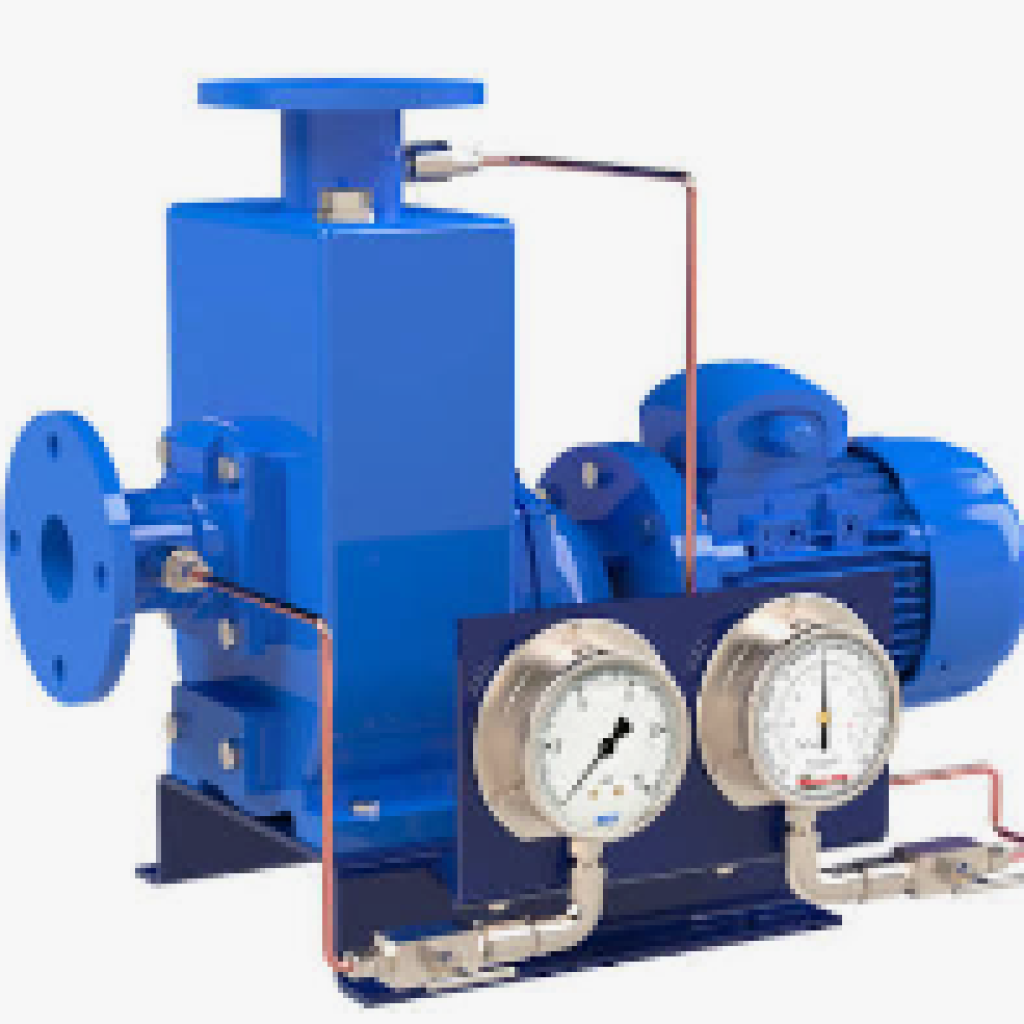
The workhorse of marine vessels and chemical plants, end-suction centrifugal pumps feature a horizontal shaft design where fluid enters axially through the suction flange and exits radially upward.
- Design Benefits: Highly economical, straightforward to maintain, and offers simple access to the impeller and mechanical seals without disconnecting the primary piping.
- Engineering Focus: Requires robust mechanical seal flushes (such as API Plan 11 or Plan 32) to prevent suspended sea solids from destroying the delicate carbon/silicon-carbide seal faces.
Horizontal Split-Case Pumps
When massive volumes of seawater must be moved—such as in municipal desalination plants or large industrial district cooling systems—horizontal split-case pumps are the ideal choice. The casing is split axially along the centerline of the shaft, allowing maintenance teams to lift the top half of the housing to inspect the entire rotating assembly without disturbing the main suction and discharge piping or moving the motor.
       Vertical Turbine Pump               Horizontal Split-Case Pump
          ┌───────────┐                        ┌───────────────────┐
          │   Motor   │                        │   Top Half Casing │
          └─────┬─────┘                        ├───────────────────┤
                │ Shaft                        │   Rotating Shaft  │
         =======█=======                       ├───────────────────┤
          │  Impellers│                        │ Bottom Half Casing│
          └───────────┘                        └───────────────────┘
Performance Matrix of Seawater Pump Configurations Seawater Pump Supplier & Services
To assist project managers in their initial engineering selection, a full-service Seawater Pump Supplier & Services maintains a diverse technology portfolio:
| Pump Configuration | Typical Flow Range (m3/h) | Typical Head Range (m) | Best Suited For |
| Vertical Turbine | $100 – 15,000$ | $10 – 300$ | Coastal intakes, offshore platform firewater, desalination lift. |
| End-Suction Centrifugal | $10 – 800$ | $5 – 100$ | Shipboard ballast transfer, bilge pumping, chemical processes. |
| Horizontal Split-Case | $500 – 25,000$ | $15 – 150$ | Main condenser cooling loops, large-scale municipal intake. |
| Submersible Marine | $5 – 500$ | $10 – 80$ | Emergency dewatering, offshore caisson drainage, ballast tank stripping. |
5. Metallurgical Excellence: Material Selection Criteria Seawater Pump Supplier & Services
The operational lifespan of a seawater pump is directly determined by its metallurgy. Selecting inadequate materials to save on upfront capital costs is a critical error. A high-tier Seawater Pump Supplier & Services provider implements advanced material sciences to match the pump components with the operational environment.
Nickel-Aluminum Bronze (NAB) Seawater Pump Supplier & Services
For decades, NAB alloys (such as ASTM B148 C95800) have been an industry standard for marine pump casings and impellers.
- Advantages: Excellent resistance to macro-fouling due to natural copper ion leaching; high fracture toughness; excellent resistance to erosion-corrosion under moderate fluid velocities ($< 3.5\,\text{m/s}$).
- Limitations: Vulnerable to accelerated attack in sour water conditions containing hydrogen sulfide ($H_2S$), which is common in stagnant harbors or polluted coastal channels.
Super Duplex Stainless Steel (25% Cr) Seawater Pump Supplier & Services
Super Duplex steels (such as Ferralium 255, UNS S32750, or S32760) feature a balanced $50/50$ austenitic-ferritic grain structure. With a $\text{PREN}$ value exceeding $40$, Super Duplex provides ultimate corrosion resistance.
- Advantages: Outstanding mechanical yield strength, allowing for thinner casing walls; nearly impervious to chloride stress corrosion cracking; excellent performance under extremely high fluid velocities ($> 40\,\text{m/s}$).
- Limitations: High initial capital cost; requires highly specialized, controlled welding procedures to maintain the precise balance of the duplex crystal structure in the heat-affected zone (HAZ).
Titanium (Grades 2 and 5)
When weight is a critical constraint—such as on offshore oil and gas production topsides—or when temperatures exceed $40^\circ\text{C}$ in high-salinity brines, titanium is the ultimate material. It forms an incredibly tough, instantaneous titanium dioxide ($TiO_2$) passive film that is completely impervious to all ambient seawater chloride concentrations. An elite Seawater Pump Supplier & Services company maintains global supply lines to source titanium castings for specialized, high-criticality projects.
6. What to Look for in a Seawater Pump Supplier & Services Partner
Selecting an engineering vendor for critical marine and industrial pumping hardware requires deep technical due diligence. Use this structured framework when auditing a prospective Seawater Pump Supplier & Services provider.
1. In-House Hydraulic Testing Capabilities
A reputable pump supplier should never rely solely on theoretical calculation curves. They must possess an ISO-certified, fully instrumented hydraulic test bay capable of verifying real-world performance.
Ensure your chosen Seawater Pump Supplier & Services company can execute comprehensive testing protocols, including:
- Hydrostatic Pressure Testing: Validating casing integrity at $1.5\times$ the maximum allowable working pressure ($\text{MAWP}$).
- Performance Testing (ISO 9906): Mapping flow ($Q$), head ($H$), power consumption ($\text{kW}$), and total efficiency ($\eta$) across multiple points of the pump curve.
- NPSH Testing: Artificially lowering the intake tank suction pressure to map the precise point of $3\%$ head drop, defining the pump’s true $\text{NPSHr}$ profile.
[Intake Suction Tank] ──► [Test Pump Setup] ──► [ISO 9906 Flow Meters] ──► [Calibrated Torque Sensors]
2. Computational Fluid Dynamics (CFD) and FEA Expertise
Before casting a single metal component, advanced design engineers model internal fluid mechanics using CFD. This software allows a forward-thinking Seawater Pump Supplier & Services engineer to visualize velocity vectors, isolate localized low-pressure zones that could cause cavitation, and optimize the hydraulic profile of the impeller vanes to maximize efficiency. Concurrently, Finite Element Analysis (FEA) ensures the structural thickness of the casings can handle dynamic hydraulic forces and piping stresses without flexing.
3. Dedicated Engineering and Technical Field Services
Hardware procurement is only half the battle. A full-lifecycle Seawater Pump Supplier & Services vendor must maintain a rapid-deployment team of field service engineers. These specialists should be certified to deploy offshore or enter remote facility sites at a moment’s notice, equipped with laser alignment tools, thermal imaging gear, and dynamic field balancing rigs to resolve unexpected on-site system operational failures.
7. Comprehensive Engineering Services Checklist
Partnering with an elite Seawater Pump Supplier & Services company provides access to advanced technical workflows designed to maximize the lifespan of your rotating machinery.
Precision Laser Shaft Alignment
Misalignment between the pump shaft and the driver motor shaft is a leading cause of premature bearing failure, mechanical seal leakage, and structural vibration. Standard dial-indicator methods are time-consuming and prone to human error.
A professional Seawater Pump Supplier & Services crew utilizes dual-beam laser alignment systems. These systems compute multi-axis offsets down to a fraction of a micron, factoring in “thermal growth” variables—the natural expansion of metal housings as they warm up to operating temperature. Proper alignment eliminates radial stress, extends bearing life, and minimizes energy consumption.
         Laser Emitter                   Laser Receiver
         ┌───────────┐                   ┌───────────┐
      ===┤Motor Shaft├==============► ===┤Pump Shaft ├===
         └───────────┘                   └───────────┘
               ▲                               ▲
               └───────── True Alignment ──────┘
Dynamic Vibration Analysis and Spectrum Diagnostics
Vibration is the language of rotating machinery. By using high-frequency accelerometers attached to bearing housings, a skilled Seawater Pump Supplier & Services diagnostics technician records real-world vibration velocity and acceleration.
The raw time-domain data is processed using Fast Fourier Transform ($\text{FFT}$) algorithms into a frequency spectrum. By analyzing specific vibration frequencies, the team can pinpoint internal mechanical defects without opening the pump, including:
- 1X Running Speed: Indicates residual rotor unbalance or bent shafts.
- 2X Running Speed: Signifies structural component misalignment.
- High-Frequency Broadband Noise: The clear indicator of active hydraulic cavitation tearing at the impeller.
- Vane Passing Frequencies ($1\times \text{RPM} \times \text{number of vanes}$): Reveals internal structural clearances or damage to the pump’s internal cutwater.
8. Preventive Maintenance and Lifecycle Management
To prevent expensive, unscheduled equipment downtimes, every plant must implement a rigorous preventive maintenance strategy in coordination with their Seawater Pump Supplier & Services provider.
Daily and Weekly Operational Tracking
Operations teams must monitor and log fundamental operating parameters, including:
- Inlet and outlet pressure gauge metrics.
- Bearing housing surface temperatures using infrared thermography.
- Motor current draw ($\text{Amperage}$) relative to the process flow rate.
- Visible mechanical seal dripping or cooling gland flow rates.
Semi-Annual and Annual Inspections
Once or twice a year, the pump should undergo an extended on-site inspection. A certified Seawater Pump Supplier & Services field team will execute the following steps:
- Check Mechanical Seal Wear: Verify face tracking and measure residual spring tension.
- Lube Oil Analysis: Sample bearing oil to check for microscopic metal wear particles or seawater ingress.
- Clearance Verification: Measure the wear-ring clearances using feeler gauges. As seawater erodes the internal wear rings, internal fluid recycles from the discharge back to the suction side, lowering pump efficiency. If clearances have expanded beyond code limits, the wear rings must be replaced.
[Initial Commissioning] ──► [Daily Metric Tracking] ──► [Semi-Annual Oil/Wear Check]
                                   ▲                            │
                                   │                            ▼
                          [System Optimization] ◄── [Annual Overhaul & Wear-Ring Swap]
9. Applications Across Diverse Industrial Sectors
Seawater pumping systems are vital to several global industrial and maritime sectors. A premier Seawater Pump Supplier & Services partner delivers specialized configurations tailored to these diverse application profiles.
Reverse Osmosis Desalination Plants
Desalination facilities turn seawater into fresh municipal drinking water.
- The Application: Large intake pumps draw seawater into the facility’s filtration systems, followed by high-pressure multi-stage pumps that push the saltwater through reverse osmosis ($\text{RO}$) membrane arrays.
- Engineering Needs: High-pressure pumps must withstand pressures up to $70 – 80\,\text{bar}$. A qualified Seawater Pump Supplier & Services provider designs these units with Super Duplex alloys to resist erosion-corrosion from high-velocity, highly concentrated reject brine.
Maritime Vessels and Global Commercial Shipping
Commercial shipping vessels require a continuous supply of seawater to keep their onboard engines and auxiliary systems running safely.
- The Application: Main engine cooling pumps, ballast water transfer systems, bilge pumps, and high-capacity marine firewater systems.
- Engineering Needs: Space is extremely limited inside a ship’s engine room. Therefore, a specialized marine Seawater Pump Supplier & Services provider supplies vertical split-case or vertical inline configurations that provide simple access for repairs within compact spatial footprints.
                               ┌──────────────────────────────┐
                               │   Shipboard Cooling Loop     │
                               └──────────────┬───────────────┘
                                              │
         ┌────────────────────────────────────┼────────────────────────────────────┐
         ▼                                    ▼                                    ▼
   Main Cooling Pumps:                  Ballast Transfer:                    Firewater Systems:
 ┌──────────────────────────┐         ┌──────────────────────────┐         ┌──────────────────────────┐
 │ • Heavy continuous duty  │         │ • High flow, low head    │         │ • Rapid emergency start  │
 │ • Critical engine safety │         │ • Rapid tank balancing   │         │ • Corrosion-free standby │
 └──────────────────────────┘         └──────────────────────────┘         └──────────────────────────┘
Offshore Oil & Gas Platforms and FPSO Vessels
Offshore production assets operate in some of the most isolated and challenging environments on earth.
- The Application: High-capacity seawater lift pumps, seawater injection units for reservoir pressure maintenance, and platform emergency firewater systems.
- Engineering Needs: Extreme reliability is mandatory; a pump failure offshore can halt entire production streams. A specialized Seawater Pump Supplier & Services vendor builds these systems with exotic nickel-alloys or titanium, packaged inside heavy-duty structural skids certified to stringent oilfield standards (such as API 610).
Coastal Power Generation Facilities
Conventional nuclear and fossil-fuel thermal power stations are often built along coastlines to secure a steady supply of cooling water.
- The Application: Massive circulating water pumps ($\text{CWPs}$) that feed cooling water through main steam condensers.
- Engineering Needs: These installations require moving massive volumes of water—often exceeding $50,000\,\text{m}^3/\text{h}$ per pump. A premier Seawater Pump Supplier & Services provider installs custom concrete volute or massive vertical axial-flow pumps to handle these high-volume requirements efficiently.
10. Advanced Engineering Problem Solving: Real-World Case Studies
Analyzing real-world engineering interventions highlights the value an expert Seawater Pump Supplier & Services provider brings to complex industrial facilities.
Case Study 1: Resolving Impeller Failure at a Coastal Refinery
A major coastal petrochemical refinery was experiencing recurring impeller failures on its primary seawater cooling pumps. The impellers, constructed from standard 316 stainless steel, were failing every six months due to severe cavitation and pitting, causing unexpected plant turnarounds.
- The Investigation: The refinery contacted an expert Seawater Pump Supplier & Services company to run an asset audit. The field engineering team installed high-frequency vibration sensors and ran an $\text{NPSH}$ analysis. They found that changes in seasonal low-tide levels dropped the suction pressure below design limits, causing heavy cavitation.
- The Engineering Intervention: The pump supplier redesigned the impeller profile using Super Duplex UNS S32750 metallurgy and integrated a specialized inducer onto the shaft inlet. This modification lowered the pump’s internal $\text{NPSHr}$ profile by $35\%$.
- The Outcome: The updated pump has operated continuously for over four years without a single drop in hydraulic performance or visible material pitting, saving the refinery more than $\$600,000$ in maintenance costs and lost production time.
       [Seasonal Low-Tide Drop] ──► Low Suction Pressure ──► Heavy Cavitation
                                               │
                                               ▼
     [Pump Supplier Intervention]: Super Duplex Upgrade + Low-NPSHr Inducer
                                               │
                                               ▼
                   [Result]: 4+ Years Continuous Operation Zero Pitting
Case Study 2: Upgrading a Cruise Liner’s Ballast System
An international cruise line operator was facing biofouling and bearing failures within its main ballast pump network, which fouled internal valves and increased fuel consumption due to weight imbalances.
- The Investigation: The operator engaged a marine-certified Seawater Pump Supplier & Services team during a scheduled drydock. The inspection revealed that the internal rubber bearings were heavily scored by sand particles, and micro-mussels were growing inside the pump’s inner volute.
- The Engineering Intervention: The service technicians replaced the old bearings with state-of-the-art silicon-carbide ceramic bearings, which are impervious to abrasive sand scoring. Concurrently, the pump casings were lined with an eco-friendly anti-fouling epoxy coating, and the impellers were upgraded to Nickel-Aluminum Bronze ($\text{NAB}$).
- The Outcome: The ballast system’s transfer time was reduced by $20\%$, bearing life extended four-fold, and biofouling was eliminated, lowering the cruise liner’s drydock maintenance costs.
11. Future Trends in Marine Fluid Handling Technology
The pumping industry is continually evolving, driven by digitalization, automation, and environmental sustainability. When choosing a forward-thinking Seawater Pump Supplier & Services provider, look for a company that integrates these next-generation technologies into their offerings.
Smart Pumps and Predictive AI Analytics
The integration of the Industrial Internet of Things (IIoT) is transforming traditional pumps into smart, self-monitoring assets. Advanced suppliers install wireless vibration, pressure, and temperature sensors directly onto the pump housing. The real-time data is processed by cloud-based AI algorithms to predict failure points weeks before they occur.
By analyzing micro-trends in power draw and vibration signatures, the system alerts maintenance crews to order replacement parts or schedule repairs proactively. This shifts operations from a reactive “run-to-failure” model to a highly efficient Predictive Maintenance framework.
[IIoT Pump Sensors] ──► [Cloud AI Algorithms] ──► [Predictive Failure Alerts] ──► [Proactive Service]
Eco-Friendly Anti-Fouling Material Coatings
Traditional anti-fouling systems relied heavily on toxic chemical biocides or copper-leaching paints that harm marine ecosystems. Today, a sustainable Seawater Pump Supplier & Services provider utilizes next-generation non-toxic coatings, such as hydrophobic fluoropolymer and biomimetic silicone linings. These ultra-smooth surfaces prevent marine larvae from anchoring to the metal without releasing toxic chemicals into the sea. Additionally, these smooth coatings reduce boundary-layer surface friction, improving the pump’s total hydraulic efficiency by $2\%$ to $5\%$.
Additive Manufacturing (3D Printing) for Critical Spares
When a customized pump impeller fails in a remote location, waiting months for a traditional foundry to construct molds and cast a replacement component is a significant operational bottleneck. Modern Seawater Pump Supplier & Services companies use industrial 3D printing (Direct Metal Laser Sintering) to print complex impellers or wear rings directly from digital CAD files using Super Duplex or titanium powders. This cutting-edge capability cuts component lead times from months to days, drastically reducing down-time for critical infrastructure assets.
12. Troubleshooting Common Seawater Pump Failures
Even with high-quality designs, industrial equipment can encounter unexpected issues. This handy reference guide, prepared by our field engineering team, helps isolate and troubleshoot common system faults.
Problem: Sudden Drop in Discharge Pressure and Flow
- Potential Causes: Cavitation damage; high wear-ring clearance due to sand erosion; biofouling blockage in the suction strainer; incorrect motor rotation.
- Diagnostic Actions: Inspect the intake strainer for marine growth; measure the motor’s operating current draw; check the internal wear-ring gap using a feeler gauge; run a vibration check to look for cavitation profiles.
Problem: Excessive Vibration and Noise
- Potential Causes: Misalignment between shafts; bent rotor shaft; damaged or worn ball bearings; impeller unbalance caused by uneven material pitting or biofouling accumulation.
- Diagnostic Actions: Execute a laser alignment audit; run an $\text{FFT}$ vibration analysis to check for imbalance or structural looseness; inspect the shaft runout using a dial indicator.
Problem: Rapid Mechanical Seal Failure
- Potential Causes: Stagnant seawater causing crevice corrosion under the seal sleeve; abrasive sand crystals scoring the seal faces; dry running caused by air pockets in the suction line.
- Diagnostic Actions: Verify that the mechanical seal flush line (e.g., API Plan 11) is clear and unobstructed; transition to ultra-hard silicon-carbide vs. tungsten-carbide seal faces; ensure the pump housing is fully vented before startup.
                    ┌────────────────────────────────┐
                    │     Pump Troubleshooting       │
                    └───────────────┬────────────────┘
                                    │
      ┌─────────────────────────────┼─────────────────────────────┐
      ▼                             ▼                             ▼
Pressure Drop:                High Vibration:               Seal Leakage:
┌──────────────────────────┐  ┌──────────────────────────┐  ┌──────────────────────────┐
│ • Check intake strainer  │  │ • Perform laser alignment│  │ • Clear flush lines      │
│ • Measure wear-ring gaps │  │ • Run FFT spectrum check │  │ • Upgrade face hardness  │
│ • Confirm shaft rotation │  │ • Inspect for balance    │  │ • Vent air before start  │
└──────────────────────────┘  └──────────────────────────┘  └──────────────────────────┘
13. Frequently Asked Questions (FAQ)
To assist procurement teams and plant engineers in making informed choices, we have compiled answers to the most common questions regarding Seawater Pump Supplier & Services workflows.
Q1: Why can’t I use standard 316 grade stainless steel for long-term seawater pumping?
While 316 stainless steel performs well in freshwater and mild chemical environments, its low $\text{PREN}$ value ($\sim24$) makes it highly vulnerable to localized pitting and crevice corrosion in warm or high-salinity seawater, especially when fluid velocities are low or stagnant. For reliable, long-term service, an experienced Seawater Pump Supplier & Services company recommends upgrading to Super Duplex stainless steel ($\text{PREN} > 40$) or Nickel-Aluminum Bronze.
Q2: What is the optimal velocity limit for seawater flowing through a pump system?
Velocity limits depend heavily on the metallurgy used:
- Standard Carbon Steel (Lined): Should be restricted to $< 1.5\,\text{m/s}$ to prevent lining erosion.
- Nickel-Aluminum Bronze (NAB): Can handle velocities up to $3.5\,\text{m/s}$.
- Super Duplex Stainless Steel: Highly resistant to erosion, safely handling high-velocity flows exceeding $40\,\text{m/s}$.
An experienced Seawater Pump Supplier & Services engineer uses these velocity limits to size suction and discharge piping, balancing flow rates with the material limits to prevent erosion-corrosion.
Q3: What is an API Plan 11 mechanical seal flush, and why is it important for seawater?
API Plan 11 is a mechanical seal piping configuration that takes high-pressure fluid from the pump’s discharge flange and routes it directly into the mechanical seal chamber. This continuous flow keeps the seal faces lubricated, vents air pockets out of the seal chamber, and flushes away any abrasive sand or salt crystals, preventing surface scratching and premature seal leakage.
     [Pump Discharge Flange] ──► [Plan 11 Bypass Pipe] ──► [Seal Chamber Injector]
                                                                  │
                                                                  ▼
                                                      Flushes Away Solids & Heat
Q4: How frequently should a seawater pump undergo dynamic balancing?
Dynamic balancing should be performed during the initial manufacturing assembly, whenever a new impeller is installed, or after executing structural repairs on the rotating assembly. Operating an unbalanced impeller creates high centrifugal forces that damage bearings and mechanical seals, leading to premature pump failure.
14. Procurement and Engineering Verification Checklists
Before signing an industrial contract or finalizing a purchase order, use these concrete checklists to align your procurement goals with technical requirements.
Engineering Specifications Checklist
- [ ] Confirm that the Net Positive Suction Head Available ($\text{NPSHa}$) calculated by the plant engineering team exceeds the pump’s $\text{NPSHr}$ by a safety margin of at least $1.5\,\text{meters}$.
- [ ] Verify that the pump casing metallurgy features a $\text{PREN}$ score higher than $40$ if the system will handle process seawater temperatures above $25^\circ\text{C}$.
- [ ] Ensure the motor sizing calculation incorporates the high density and specific gravity of seawater ($\sim1.025$) to prevent motor overloading.
- [ ] Verify the mechanical seal faces are specified as Silicon Carbide vs. Silicon Carbide to handle suspended sand and debris.
- [ ] Confirm the pump baseplate design matches the site’s structural foundation requirements and includes grounding lugs for galvanic protection.
Vendor Verification Checklist
- [ ] Confirm the provider has an active, in-house hydraulic test facility certified to ISO 9906 standards.
- [ ] Ensure the field service team maintains valid certifications for specialized site access (e.g., BOSIET/OPITO for offshore platforms).
- [ ] Verify the supplier provides full material traceability, including Mill Test Certificates (MTCs) for all wet-end parts.
- [ ] Confirm the vendor stocks critical spare parts (such as wear rings, shafts, and mechanical seals) in a local warehouse for rapid distribution.
- [ ] Review case studies verifying the vendor’s past performance on similar large-scale marine fluid handling projects.
15. Conclusion: Ensuring Long-Term Hydraulic Reliability
Sourcing a marine or industrial pumping system is a critical long-term investment. Cutting corners on metallurgy, ignoring proper $\text{NPSH}$ calculations, or partnering with a general-purpose water utility vendor can result in unexpected failures, costly plant downtimes, and severe financial losses.
By prioritizing experienced partners who understand the complex chemistry of marine fluids, utilize advanced computational design tools, and offer rapid field engineering support, you protect your capital investment, your personnel, and your operational timeline. When you require exceptional hydraulic efficiency, advanced material engineering, and comprehensive lifecycle support, partnering with a premier, certified Seawater Pump Supplier & Services company is the most secure path to long-term operational success.
Contact Information:
- Website: https://flomek.com
- Email: sales@flomek.com
- Phone: +65 1234 5678
- Address: 123 Industrial Avenue, Singapore 567890
Get in touch with us today to discuss your project or request a quote. Let Flomek help you find the perfect pump solution to keep your operations flowing smoothly. Pump manufacture in yishun
Also Read – Best pump services Pump manufacture in yishun
Copyright © Flomek 2024, All Right Reserved.Designed and Developed by ❤️ Krigo Softwares


Leave A Reply